Pages

Thursday, January 19, 2012

Universal healthcare.

I am interested in politics. I am particularly interested in American politics - partly perhaps out of masochism, and partly because I think it is everyone's duty to care about what goes on in this weird, huge country, because for better and for worse, it impacts the rest of the world and has for over a century. One particularly hot topic which, I think, baffles a great number of Europeans (and Canadians) is that of socialized healthcare. Like many others, I'm not sure what the deal is, since it's a system that has been in place for years in many countries and that is undoubtedly functioning. In spite of this, the apocalypse has yet to happen, so why is the Republican party acting like a universal healthcare system will be the world's downfall?

I recently had an exchange about this on Tumblr with someone on the complete opposite side of the political spectrum, and she reiterated with the following list of worries, complaints and issues that I would like to respond to. I will also post my response on Tumblr for her to see, but I like the Blogspot format better, so I wanted to share my viewpoint here as well

1. Any “universal” infrastructure is expensive. We’re talking trillions of dollars to ensure that every individual is provided health-insurance. Considering only about half of the population pays taxes, this unfairly shoulders the tax burden on the few who do pay taxes (the middle class). The poor are often exempt from paying taxes all together, though they would be the ones receiving the benefits from a universal system.

I think this comment suffers from something I just decided to call 'poor-phobia' - the idea that The Poor are somehow the others, not like us, who live in a different city, on a different street, on a different block. Universal healthcare is not a benefit extended by the huge middle-class majority to a small group of 'poor people' who are Too Lazy To Work and Probably On Drugs. From what I have seen in this country, and read about, I am fairly sure these uninsured poor people are not some sort of alien minority. These are very regular people, often from a middle-class background, who are in school, or whose job doesn't provide benefits, or who were laid off because of the recession. I don't like to talk about 'the poor' - because I think that poverty is much more pervasive than that phrase appears to indicate.

2. When the quantity demanded of a good exceeds the quantity supplied, there is a shortage. If every individual in the nation now wants to see a doctor, there is going to be a shortage of doctors. This manifests in to longer waiting times.

I have various issues with this statement. First of all, it seems to believe in sacrificing the needs of the many for the comfort of the few - we can't have universal healthcare, because then everyone would get to see a doctor, and then those people lucky enough to have money or good medical insurance would have to share their doctors with these people! If there's not enough doctors, that's an issue - but the solution can't be to withhold medical care from people who can't afford it.

Also, and I realize this is anecdotal evidence - I've always been able to see a doctor MUCH quicker in Belgium or in the UK than I have over here. And I have a number of US friends who have literally had wait months to see X or Y doctor. So if you're talking about waiting times... how much worse can it really get?

3. The shortage of doctors is exacerbated because there is a lack of an incentive to become a doctor. Doctors typically become doctors in order to make money (as any other rational individual pursues a field). However, if the government is now involved in the health-care industry and can decide how much a doctor must be paid for his services, you will find less people wanting to become doctors.

Well, first of all, not everyone becomes a doctor solely to make money. Like nursing and teaching, I believe one needs a certain calling to become a doctor - I think I'm smart enough to pursue medical studies, but I don't feel the least urge to poke around someone else's body. Some people however find that interesting and find they can help people by pursuing that interest. Monetary gain is not everyone's number one stimulus.

Furthermore, I'm not sure where this even comes from. Doctors are still extremely well-paid in Europe. There is still a certain prestige attached to the profession - only their wages are provided by the government or government-sponsored insurance instead of by individuals or for-profit insurance companies. I assure you, doctors are living more than comfortably, even under this evil socialist system - and last thing I heard, there are still plenty of people who wish to pursue medical studies.

4. The quality of care is reduced in order to fill the shortage of doctors. If everyone is demanding a doctor, and the government “needs” to fulfill the demand, it will inevitably be led to hire underqualified doctors.

Once again, inevitably? I feel like many of these arguments are regurgitated blindly from right-wing propaganda sources, because I honestly believe that there is no marked difference between doctors in Europe and doctors in the United States. I've seen my share of doctors and specialists, and I assure you they are not some gang of plucked-off-the-street drug addicts who had to sign two forms and they're a doctor now. A lot of this just strikes me as pointless fear-mongering.

5. When the demand for a good (health-care) increases, the price of the good also goes up. If everyone now demands health-care, its price will increase exponentially. You hear the term death panels thrown around a lot, but if there are thousands of people on the list who need a kidney, there needs to be a way to decide who actually gets it. This creates corruption.

If you genuinely believe death panels are a real thing, then I truly have no words. Trust me. They're not. Once again, I see you using the 'universal healthcare means more people would be able to get medical attention and that's bad!' argument, which just doesn't fly. Nobody is on a list for a kidney without a good reason. Are you really saying that 'poor' people don't deserve to be on such a list? If the healthcare system cannot handle more patients, then the solution is to reform the system - not to deny care to patients based on income.

6. Any universal system will face corruption. People who are able to afford better health-care are going to demand it. If there is such a shortage of doctors, and long waiting times since everyone in the entire country is going to see the doctor, an extra exchange must be included to make sure you are seen first (if at all) and provided the necessary care. This often leads to a black market in health-care, as people are now willing to dish out a lot of money to make sure they’re given priority.

A black market in healthcare? Does this stuff come from a James Bond novel? Once again - THIS IS NOT SOMETHING THAT IS REALLY GOING ON in countries with socialized healthcare. And also once again - the way to deal with long waiting times if there aren't enough doctors (which for the reasons I explained above, there are... doctors still make plenty of money) is to offer incentives and make sure there are sufficient doctors to deal with everyone... not to cut people off from the healthcare they need. Healthcare is a basic human right. Most countries have figured this out.

7. There is an incentive to abuse the universal health-care system since it is “free”. In America, we see that people who are provided government health-care often abuse the system by going to doctors and emergency rooms for routine colds, headaches, or things that can be easily treated at home. Elderly people on Medicare often go to doctors multiple times a week, even if they do not have any pressing health concerns. Even if there is nothing wrong, people will see that they can get something for “free” and take advantage of it.

I am skeptical about the fact that people would suddenly go see the doctor practically for entertainment purposes if it were free (medications aren't free even in a socialized healthcare system, by the way - though they're cheaper than they are in the US). However, even if this were to be the case, I had rather 10 people go see the doctor for a cold than that one person wouldn't be able to see the doctor if they have cancer. Fix the system, regulate the system, but don't give up on what is essentially a good idea because of a list of hypotheticals.

8. Due to the abuse of the system, there will be a decrease in quality and an increase in waste. This is pretty simple: if doctors are being tied up treating people for ailments that are not significant, there will be longer waiting times, less resources to be allocated towards you, and more money being funneled in to the system.

You keep repeating yourself. Once again - I do not actually think this decrease in quality is borne out by reality in countries where socialized healthcare is a fact. You seem to imagine these countries as though they're all North Korea. I have a serious and incurable visual impairment as well as a blood disorder, and I have received quality healthcare for both - for free, or at least much more cheaply than would have been the case in the US.

9. There is a lack of incentive to actually care about patients; in fact, there is an incentive to treat patients poorly. If you have hundreds of patients every single day, and they are all required by law to only see you, you do not care about the well-being of the patient. Once one leaves or dies, another one will fill their place. You’re getting paid no matter what.

They're all required by law to only see you? In some countries, people are in fact assigned to a certain physician - but in many countries, that's not the case. For example, where I am from, you can basically go see any doctor you want.

As for not caring about the well-being of the patient - where are you getting this information? I suspect it's simply made up. I don't even know how you'd go about measuring that.

10. The government will view you as a number rather than a patient. The relationship between many doctors and patients are unique, in that there is compassion in bedside manners. However, if a doctor sees hundreds of patients every day, there is no ability for a doctor to genuinely care about his patients.

Once again: fear-mongering. Not fact-based. You have implied before that the left isn't using rational arguments, but exploiting people's fears isn't rational either.

11. Any way you slice it, you are putting bureaucrats in charge of a personal decisions that should be made between you and your doctor.

I am not sure how. I can assure you that my doctor does not call the government before prescribing me sinus medication. I always feel as though people talking about the spectre that is 'universal healthcare' believe it instantly turns a country into a communist superpower in which people are but cogs in the great, red wheel turning and turning to the greater glory of the Great Leader. This is not the case. Our countries are not so very different, and Europeans are no less free than Americans. There are no cameras in every room.

Also, I think it would benefit many people who wave these arguments around to actually conduct a poll in a number of European countries and investigate how people really feel. I think you will find that although a number of people will complain about the healthcare system and point out issues, almost none would be willing to trade it in for the American system. Because universal healthcare, for all this talk of 'death panels', works.

I am not saying it would be easy to create such a system for a nation of 300 million people, and I am not saying that there wouldn't be certain abuses to be contended with - but those are no reasons not to at least give this idea a chance.

Healthcare is a basic human right.

Thursday, January 5, 2012

A few Parisian pictures.

I will probably upload the pictures on Facebook later, but I wanted to post a couple here, with comments. I took these on the surprisingly good RetroCam app on my Android phone - I much, MUCH prefer Hipstamatic, but I don't have an iPhone and getting my iPad out is such a hassle for quick pictures. Still, this camera did not actually disappoint. I like the polaroid effect, and it does great things with contrast.

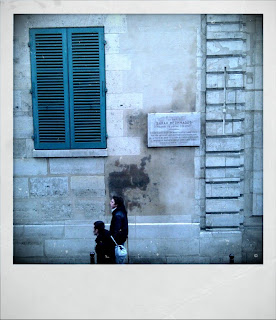
The house where Sarah Bernhardt was born - we came across this place completely by accident, since we had lunch shortly after our arrival in a place just across the street and then spotted the plaque. Still, pretty cool. I like Bernhardt.

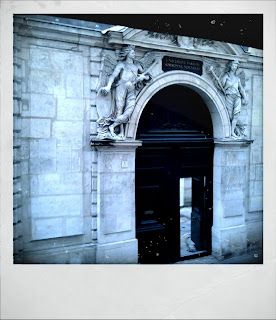
One of the buildings of the Sorbonne. I really like this shot. I like places where everything is old and beautiful, except the subway, which smells.

Because I'm easily amused, I come bearing Happeh Hasidic Child versus Angreh Hasidic Child. I didn't actually buy either book, but they looked hilarious. The second one obviously says 'KVETCH', by the way, and deals with Yiddish.

Les Deux Magots - an overpriced café where Sartre and de Beauvoir supposedly hung out back in the day. Also possibly Racine, but not at the same time, and that may be made up.

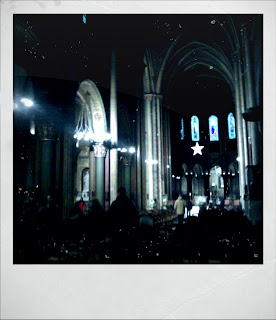
The inside of Saint-Germain-des-Prés. I really love Gothic architecture, even if I dislike the heavy, incensey scent that always seems to hang around in those old churches.

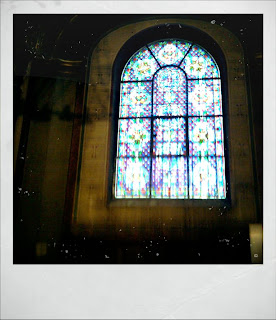
I also love stained glass windows. Same church.

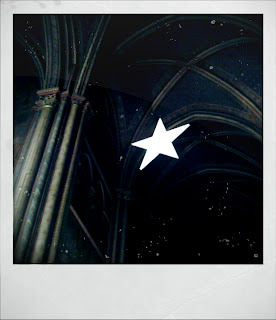
And a closer look at the star near the front. I really, really like this picture a lot. This camera app does a good job for contrast shots like this one.

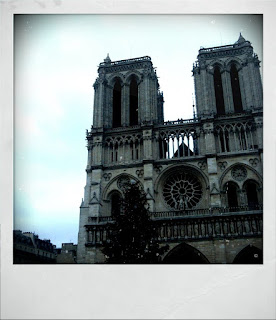
Notre Dame. We didn't go inside... yet again... because the line is always crazy long. I need to investigate if there is a way to pre-order a ticket online, because I really want to see the inside. At least I've been inside the Sainte-Chapelle before, I guess - the line for that one was crazy as well.

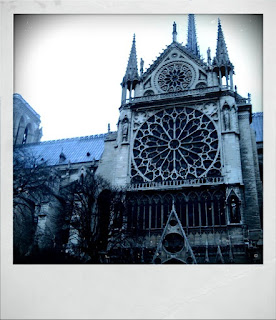
Another view. I love the architecture of this church. It has a fairly interesting floor plan.

The gargoyles, seen from below. This picture turned out a lot trippier than it was intended, but I like it. They really are a fine example of the nutty side of Gothic. I love them.

Inside picture of the restaurant we had dinner at. The food was nice, but the menu was littered with weird French shit. I can say that, I'm Belgian. I don't want obscure meat on the bone, I don't want soup made out of shellfish, and I don't want to suck marrow out of a bone. I realize those don't sound that weird. I'm going to be quiet now. Good food was had.

I actually forget what this was. My mother and I have a tendency to just... walk through random gates. One day someone's gonna shoot us as trespassers, or something. But hey, it looks pretty.

Then, we went to Jewville, kind of - but only kind of - getting lost on the way. This was an old synagogue in the Rue Pavée. I like Judaism for many reasons, but one superficial one is the fact that a star is just a much nicer and less horrifying religious symbol than a cross. I mean, who are you gonna kill using a Star of David? An insect? (Six legs! You could conceivably crucify an insect on a Star of David! I'm going to be quiet now.)

We had lunch at an interesting Israeli falafel place. For some reason, I turned into a photography noob, and this is the only picture that turned out decent - the little Israeli flags on the wall just beside us. The food itself was good, but way too much. Which tends to happen at falafel places.

Of course, there were also heaps of bookstores - one was called the Temple Bookstore, or something like that, and it was beautiful. Of course, I made random purchases, some of which can be seen here. I bought Le Petit Prince in Hebrew/Yiddish - if you turn it over, it has the Yiddish text. This is good, because I can read Yiddish if I read it out loud. Mostly. The postcards are illustrations from Medieval Hebrew manuscripts. Score!


The red Christmas trees on the sixth floor of the Centre Pompidou. I oddly liked them.

And the view. This was the Sacré-Coeur on Montmartre. I really like how well you can see the hill.

And the Eiffel Tower. We didn't go there - I've been to the top three times before, and it's usually crazy crowded - but I figured I had to at least see it to make the Paris trip complete. :)

Okay, this turned into a much longer post than was intended, but oh well.

Wednesday, January 4, 2012

Paris s'éveille, if not too early...

I spent the past two days in Paris with my mother - we went there by train (which only takes about an hour from Brussels) and spent one night at a hotel, which was nice. Though Paris is very close, it had been over a year since I'd been there, so this trip was a lot of fun.

Our original goal in going there was the Munch exhibition at the Centre Pompidou, although I'm not sure why that was our goal since neither of us actually even knew where Munch was from. We eventually decided on the Czech Republic, but of course he turned out to be Norwegian. To complete the picture of total cluelessness, we also thought they had The Scream, but then they didn't. Anyway, it was an interesting exhibition and I enjoyed it a great deal. We also briefly visited the other special exhibition, which was about dance, but me and dance have a love/hate relationship. On the one hand, it is near the top of my list of things I would love to be good at but am not, and I love to watch it, but on the other hand I only really love to watch it if it's ballet dance or some pretty couple dance (like swing, or charleston, or lindy hop).

We also walked around aplenty, of course, and had some excellent food - and we also visited the Jewish area, the Pletzl, which was rather wonderful. I have always had this latent, crazy obsession with all things Jewish, which is odd since I really didn't grow up around any of it, but I had never seen any of Jewish Paris. Though the streets were in many places commercialized, it was still a really nice area with an old synagogue, nice food and coffee places (Kosher certified, yo) and a lot of really nice Jewish bookstores. I was really pleased, and also spent a lot of money, which is why I should really never visit Jerusalem, though I SEKRITLY want to.

It's not that expensive on a direct flight from Belgium.

This is bad.

Friday, December 30, 2011

Ex. 103: The Day After

This is an exercise from The 3 AM Epiphany that I found very interesting - basically the assignment was the following:

Imagine a moment just after some major historical event. Use ordinary people, not the Napoleons or Nancy Reagans. This will demand some research. Don't be afraid. It may be that these people have no idea what has just happened. 800 words

Clearly this is an interesting prompt for history nerds, and I'll probably use it again sometime to tackle a more contemporary topic. For now, I chose to write about the day after the death of Christ, because, though I don't particularly consider myself a Christian, it's undeniable that that day in history set a movement into motion that has changed the world several days over. At the same time though, I suspect most people at the time literally could not care less that yet another random dude with wild ideas had been executed by the Romans.

Please note that the exact date mentioned here is just a random suggested date I found on Wikipedia or something - I know that obviously the Roman (or Jewish) calendar would not have looked like this at the time, and I know that Christ may not even have died in 33 AD.

Saturday, April 4th, 33 AD

“A drink of wine, centurion?”

Devorah smiled broadly as the soldier in full Roman uniform entered the tavern, even if she was well aware he was no centurion. Having grown up under Roman occupation, she was better acquainted with the different insignia and their significance than most of the raw recruits who drank the cheapest brew she served.

This one was, she guessed, in his early twenties – old enough to have seen a little combat, perhaps, but young enough to have enjoyed it. A Marcus, she thought. They were all called Marcus or Lucius, these foreigners. It made things easy.

Marcus looked at her a little surprised, then grinned.

“Sure, sweetheart. Fill my cup to the top.”

He was sweaty and red in the face – without the tanned, leathery skin some of them developed after a long stay. Fresh off the boat, probably.

Devorah smiled again. New Romans, lonely for familiar food, familiar faces and a familiar girl in their beds, were good custom.

The soldier hoisted himself onto a high stool and looked her up and down as she handed him a cup of watery, cheap wine.

“You’re the first Jewess in this whole damn place who’s been friendly to me. What’s wrong with you girls?”

As she gently pushed a small plate of salty olives – complimentary, and very much included in the bill – his way, Devorah leaned her crossed arms on the bar.

“Well, centurion, today’s Shabbat, so you won’t be seeing many girls out anyway. It’s forbidden for Jews to work on the seventh day. As for any other time, I couldn’t tell you, but some find the uniform off-putting…”

She grinned, popping an olive into her own mouth and enjoying its greasy taste on her tongue.

“Then what sorta Jewess are you?”

It was not a bad question at that, Devorah thought to herself. She shrugged.

“Not the only one of my kind.”

He looked to the side, as though verifying her answer, and Devorah began to wonder if he was drunk already. The wine, though diluted considerably, could affect one already touched by heat heavily, she knew.

His eyes, curiously light, rested briefly on Miriam, sitting in the corner with two old regulars.

“I guess you’re not.”

Devorah nodded. She knew, of course, what the Sanhedrin – what most of her compatriots – thought of girls like them, but she was nonetheless at heart a pragmatist.

When Victoriana had offered her a job, she had been grateful. Though the tavern keeper herself was Roman – the runaway daughter of a senator or the illicit offspring of a Transtiberina whore, depending on the time of day – she believed that the soldiers enjoyed a glimpse of the exotic on their days off, and Devorah was inclined to believe she was right.

She smiled and wound a hennaed curl around her index finger as she filled the soldier’s cup again. She’d pegged him as the talkative type as he’d walked in and was about to revise that judgment when suddenly, he burped, looking downcast.

“Crucified a couple guys yesterday. Depressing business.”

She made a sympathetic noise, chewing an olive.

“Awful death, sweetheart.”

Devorah was not squeamish – you couldn’t when working in a place like this – but she hadn’t ever gone to watch an execution. She was sure, as all barmaids were, that a couple of her customers had ended up nailed to the wood at some time or another, but corpses smelled, and Golgotha was a depressing place.

“My, I bet, centurion. Messy.”

That made him laugh – a loud, boisterous guffaw.

“Yeah. Messy.”

He took a deep, long swig of wine, his eyes dark.

“Three guys. Two Jews, one Ethiopian. One of ‘em was that nutter – Lucius told me he’d pissed off locals for years. What’s his name again? Boy from up North. Delusions of grandeur.”

Devorah chewed another olive and spat out the pit.

“Oh, that guy. Stole a good customer off me once - he went pious on me. Well…”

“The others were more interesting. Held out longer, too. One was a thug who robbed a couple brothels near the harbor. They were gonna stone this whore who was his accomplice, but she paid off her debt in other ways, I hear. Our centurion’s been whistling all day.”

The girl giggled and swatted his arm.

“Hush. I know the one you mean – she’s a talent!”

The man grinned, a dirty joke in his eyes.

“The other was an Ethopian, a gang leader. Big guy, black as the night – plundered a couple warehouses and also a merchant’s wife. Though I’ve heard it said she wasn’t unwilling!”

Devorah nodded.

“We’ll all know what happened when Boeotius’ wife pops out a yellow baby, I’m guessing. Can’t really blame her. If I was married to a guy without teeth and for all we know without balls, I’d know what I’d do!”

“Oh yeah?” asked the unnamed soldier who may have been called Marcus,

“What would you do, huh?”

She threw her hair back and laughed, then gestured with a snap of her head.

“Come out back, honey, and I’ll show you.”

He followed.

Thursday, December 29, 2011

Epiphany


This is the book I bought using my gift card. It's called The 3 AM Epiphany, by Brian Kiteley, and it lists a total of 201 exercises for aspiring writers. I like it because the prompts are not of the 'write about a childhood memory' variety - most of them are much more detailed and much more interesting. Some are technical (dealing with different voices and points of view, or how to construct a paragraph), others are topical (such as the sections on biography/autobiography, or on history) but none of them are particularly easy. It's a good book that I think will help me a lot. I'm currently editing the first response I wrote.

Writing

I've been writing fiction for most of my life, really. I wrote fan fiction before I even knew what it was, since as a child, before I fell asleep, I used to tell myself stories using the characters from my favorite books. I only found out that it was a real thing that other people did too when I stumbled across the Draco Dormiens trilogy (Harry Potter fanfiction) when I was thirteen or so. It's been a slippery slope from there.

I evolved later to writing mostly original fiction, though even now, I occasionally write a one-shot to some book or tv series I enjoy. It's fun, particularly if one is the type of person who gets inordinately attached to fictional characters. I miss them when the book, the series, the movie is over, and so I enjoy keeping them alive in that way.

I did NaNoWriMo three times in high school. My first novel was a fantasy story about the sunken island of Atlantis, and though it was not the best thing since chocolate, it had certain elements that I still find interesting, such as the question whether gods and goddesses die when nobody is left to worship them. A friend of mine reminded me of that question yesterday, since it's being explored in a book series he is reading, and it made me think of my story. Which had, of course, a tragic ending.

I don't recall what order I wrote my other two NaNo novels in, but one was a historical novel set in 1960s England, starring two characters who had switched identities as teenage girls during the War. They were both French, and one was Jewish and fleeing to Canada (or someplace? I don't even recall) whereas the other was simply being evacuated to England, and they switched identities at a train station. I feel like this was based vaguely on a children's book I once read, but it also featured a murder and a bunch of really messed up secondary characters. I never finished that story, because I fear it was pretty juvenile and uninformed. My intentions were good, but I should have done more historical research. I'm still, however, fond of Sarah Schopenauer, and maybe one day I'll tell her story in another way.

The other book was actually pretty interesting. It mixed three story lines, one set in the 1500s, one set in the 1880s and one set in the 1920s, all three in England. The 16th century narrative dealt with the mysterious death of Lady Amy Dudley, who was the wife of the Earl of Leicester who may or may not have been the lover of Elizabeth I (and, at least at one time, probably was). The other narratives deal with the descendants of a distant relative who came to live with her during her final years. This story really had some potential and I had a good time writing it - it came pretty close to being finished, and I may pick it up again.

I haven't written an original story in a while, but one of my Christmas presents (once again using the Amazon gift card my friend gave me) was a book of fiction writing exercises. I hope to post some of the results on here, if I deem them un-bad enough.

Tuesday, December 27, 2011

My first thousand words?

I am mentally ten years old, and apparently prefer learning through children's books. A friend of mine was kind enough to give me an Amazon gift card for Christmas, and this was one of the four books I purchased:


It's really quite cool. I have a shaky history with vocabulary-list-style books (read: I buy them and then do nothing with them) but I'm hoping to get at least something out of this one. Even apart from my interest in Judaism, I really like Hebrew as a language and I would love to be fluent some day. It'd probably be good to learn words that are not 'mi chamocha ba'eilim, adonai' or 'eshet chayil' (though I found an Eshet Chayil song on Spotify that's awesome, but I don't think I am very much of an eshet chayil, so there you go).

We will see how it goes.